FOIL BOARD ARRANGEMENT TIPS- FOIL BOARDS, FOILS, FOIL PLACEMENT, FOOT PLACEMENT, FOOT STRAPS
Exactly how to set up your foil board to be well stabilized for maximum efficiency.
Aloha good friends! It's Robert Stehlik with Blue World Browse. Today. I'm mosting likely to discuss establishing your foil gear. It's a inquiry we obtain a lot: Just how do I set up the foil, where to put it, where to put foot bands, just how to place your feet on the board, what sort of board to get. I'm also going to discuss what sort of equipment to utilize as a novice.
And also as a more advanced foiler as well as for various sporting activities- this is my stand-up paddle foil board. I have a wing foil board and a vulnerable full board. I'm going to speak about the boards, use the foils made use of. And after that I'm also going to speak about foot placement, how to find out where to put your feet and exactly how to affix a foot band to your board.
So this video is going to be a bit longer. We have a great deal of info on our website and on YouTube too. So down below in the summary, I'll put a great deal of links to other video clips and links that will assist you better along the way. The last video clip I published was an meeting with Kane De Wilde as well as he has a lot of truly good understanding on foil arrangements and so forth.
And also he stated, he always suches as to try great deals of various configurations and also determine what jobs and truly feel it out. And that makes a lot of feeling to me. The even more. You can evaluate points the more, exactly how points interact and also just how to enhance your configuration and also having a good configuration, specifically the foil functioning well with your skill as well as just how you utilize it is incredibly crucial.
So having a excellent foil established as well as the best board and afterwards a good wing, all those things together will instantly simply make you better right now. These days I primarily right into wing hindering. This is the board I utilize the most here is my my 4 six by 78 litre wing foil board. What I talk about below today relates to all 4 sports, consisting of prone browse hindering, wing hindering, and standup hindering.
So I began hindering regarding five years earlier. And also if you look back through the YouTube history of video clips, you'll see, I initially started on an 8'0 Defend foil board that I just placed a Tuttle box into and that worked well to begin on and also discover on.
And then afterwards I would certainly developed a specialized foil board. That was a 7'6. And rather soon I felt like it was too big as well as the tail was dragging and so on. So I sliced off the tail just to see what took place and also made it into a 6'11, and afterwards that functioned really well. And I figured out, yeah, having that much shorter swing weight and the shorter board actually aids when you're hindering up on foil.
And afterwards I have actually been progressing considerably, been examining smaller as well as smaller boards. As well as currently what I utilize for wing foiling is a four six, which is pretty tiny. As well as for vulnerable surf hindering I utilize a similar length board. This set right here is a 3'10. I utilize this mostly for exercising my dock Starts, which I'm not very good at yet, but dealing with that, trying to dock start and also pump.
And then for standup hindering, I use this board right here. It's a 5 eight by 114 liter board for standing up falling. I simply need much more security.
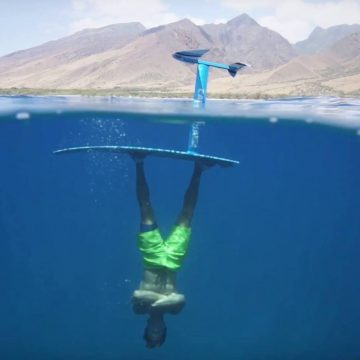
The wing master board is great for wing flooding, yet it's not secure sufficient for me to stand up paddle on possibly a lighter weight. A paddler with really great equilibrium may be able to stand up paddle on this. Generally speaking, this board is going to be also little for most people to stand up paddle for long. So something such as this, the 5'8 Truly wonderful. Stand-up foil board likewise works well as a wing foil board due to the fact that wing declaring, you have the wit lift of the wing. You do not require rather as much security as you do for standup and bouncing while you're standing up for getting started as well as wing foiling and also standup foiling.
I advise obtaining a bigger, stable board. So in our variety, we have the 6 '11 and also the 7'6 Easy Foiler versions. Those are truly good boards for discovering how to Stand up paddle foil and wing foil. And afterwards as you improve and also you fit standing up and you can perhaps change your feet around as well as do all the essentials on a larger board, then you prepare to go some to something smaller, maybe something similar to this five, eight Carver foil board, or for a little more advanced for, and also these Wingmaster boards are awesome. This is not going to be your first Wingfoil board, it's going take a larger board to first discover the essentials on, as well as after that you can function your way down to a little board like this. For me, it was lots of boards in between. And also, clearly I possess as a brand name and I created these boards. I do a lot of R & D as well as made a lot of boards gradually working my means down.
Possibly just like a couple of inches in a few liters at a time. So I really did not start on a big board as well as ended up on this immediately. There's a lot of action in between. And you don't have to take that many steps, yet I would certainly state between a novice board and also the really advanced board, there must be at the very least 2 or 3 boards.
To reach that factor where you can compose a truly little board. Don't believe you can simply begin wing filing on a little tiny vulnerable board. This is it's possible. I've seen people do it before that are extremely gifted athletes as well as already excellent filers. I have actually seen individuals find out how to wing complete on vulnerable.
The boards, however if you're an average Joe do not also attempt it. It's mosting likely to be way also hard to attempt to find out on it, tiny board. And for me it wing for the important things I suched as to have a bit much more quantity. I'm, my weight is 195 pounds. I'm 6'2" and 195 pounds which is roughly 90 kgs.
To ensure that converts right into 90 litres of volume to float me. The very first 90 litres of volume will certainly drift my body weight. And after that of course you also have to include the weight of the foil as well as the board itself. As well as as well as generally if you want it to float you, you need to have equal amount of flotation protection to your body weight. So the volume really depends upon your body weight. And then for a newbie, I advise getting a board that has sufficient volume to float your body weight, plus perhaps 20%. For me maybe as a beginner, I would use a boy that's at least about 120 liters, maybe more that will be good to float me.
For evaluating hindering for standup foiling, you could get something even a bit bigger. Perhaps for me, I would certainly select like 140, 150 litres and sufficient size as well as length and security to be able to send a paddle on and also learn on. And after that as you improve with the harmonizing and catching waves and also getting up on the foil, after that you can relocate smaller sized and also the foil does include security to the board.
Having a foil board is going to be a lot more steady than a routine standup paddleboard, yet it's a certain sort of equilibrium that you have to get used to it. Does not. Just immediately make stabilizing easy. It's just a little hold-up, so it decreases the movement of the board a little bit in that foil beneath.
It's like having a keel under your board. So next let's speak about the foils themselves. I have actually been doing this a long period of time. I make use of fairly a small foil now for wing foiling, especially like for waves and also stuff like that, attempting to go faster. This is an access high facet element for us.
The Axis 810, a wing span or 810 millimeters or 32 inches. And the predicted surface is 1022 square centimeters, that's about 158 square inches. So this is quite a little front wing, but because it's pretty high facet and it's really quite, has quite a bit of lift and also a lot of glide.
So I truly liked this, a front wing. I have a 760, which is a little bit more surfy, which is also a really nice but for starting out on, When I started, I used a really big foil, the 2000 square centimeter foil. So when you're starting something like the Carver foil, We have the team plan at Carver for is a great forum for understanding.
It's 2000 square centimeters. It's steady shows look at more info up at low rates as well as flies out a little bit reduced speed, yet it just keeps sliding. If you're doing a change, if you muck it up a little bit, you have actually got means even more time to move out of the turn and keep up on the foil. As well as it just raises much easier as well as reduced speeds.
So it's this much easier to make use of a bigger foil when you're beginning. And also as you progress, depending on the problems you're winging in having a large foil is just makes every little thing a bit less complicated. And as well as it allows you to do more methods as well as things like that. These smaller foils are not for everybody, but as you get better, having a smaller foil.

And also a thinner profile, just permits you to go quicker, do tighter turns, be a lot more maneuverable as well as going quicker really aids in the waves due to the fact that a lot of times when you catching away from the outside, it's still relocating really rapid and you need to be able to stay up to date with that fast moving swell. And after that having a faster, smaller sized wing, will this aid you be able to stay on top of those waves versus if you're just riding wind swell or simply on a flat water, a Lake or something like that?
Having a larger wing behaves due to the fact that you can just fly a little bit extra gradually. It's not a big deal. And afterwards it simply gives you even more time. To remain on foil, easier to get up on foil as well as lighter winds also. There's a lot of advantages of using a bigger foil. When you're starting out, definitely get a bigger size foil something, 2000 square centimeters.

Or we also have 1,800 square centimeters, large size, something like that. And after that in terms of mass length, I like to use a 90 centimeter mast. I've attempted longer mass and that's having a actually lengthy mass behaves for downwinders it resembles that, but it does make the whole thing a little bit much more tippy on the much shorter mass.
You have to adhere to the waves up and down as the wave increases, you need to dip your nose backwards and forwards and much longer. Mass permits you just to fly right over to the smaller chops. That behaves, but I have a really in-depth video clip as well as I'll place the web link down listed below to that on selecting the very best foil for your demands.
So view that also. That's some really excellent details if you're uncertain what type of flow you're going to need. And more. Next, I'm going to talk about putting the foot on the board and where to put it. So my vehicle is rather tiny, so I have to take the foil off the board as well as placed it back on. Whenever I use it.
As well as because of that, I acquired this, the influence chauffeur, which is a really nice tool to have truly makes it very easy to place the foil on and off. And for me, yep, I typically simply maintain the bolts in the board as well as I tightened them down, so they can not move. I just loosen up these four bolts. You don't want to leave them in the board loose since it can slide out.
And then if they drop out while you're bring the board and the grass or something like that, these are very easy to lose. So I always make sure these are tight sufficient, so they can not glide out by themselves. And also I stated, the mass plate that has, that enables you to move the screw onto it. And after that I like to simply tighten them down. Okay. Little, get them all in place.
Once they're all located, after that you can crank them down. You definitely want to make sure they're tight on there because you don't desire these screws to loosen up while you're riding.
So currently I got the complete on the board. And the next concern is exactly how do you position the foil on the board? And that actually, it truly depends on the foil itself and also the board, the dimension of the board Kindle while generated a excellent approaches. Have a excellent beginning point of where to place your foil. Which's simply, if you raise the whole setup from the thickest factor of the foil, the think is indicating the initial concerning a third back on the profile.
To ensure that's where the facility of lift is so that the front wing creates a lift center of lift is right here at the thickest part. If you lift up your setup from that point, your board should be pretty much level. If your board is level. That indicates the center of gravity of your entire system is straight below the facility of lift of the foil.
So after that let's state this, you project that to below after that on the other side of the board, if you consider that same point on the deck, This ought to be basically in between your feet. So if your feet are as well much onward, you're mosting likely to have to place more weight on the back of, on your back foot. If your feet are also far back, after that you need to lean more on your front foot.
So preferably you want to have your feet similarly balanced to make sure that the center of lift is right between your feet. And then if it's additionally the center of gravity of the entire system, it'll simply really feel way more balanced. The weight of the system and the center volume all balance out that actually aids. And this is virtually real for all sides boards, that whether it's a large standup foil board or a smaller vulnerable board that canceling is a actually good beginning factor on where your foil will work best as well as where you can stand as well as capture the wave and in the ideal place, or take off and place your feet in the best place.
Primarily where the quantity as well as the weight of the board and also the weight of the whole system. Whatever is perfectly balanced out. Kay. Next allow's talk about your foot positioning. My feet are about equally balanced out between the front and the back of the center of lifts. If you predict the facility of listing of the front circulation in between your feet, it's going to be essentially between your feet.
And some individuals have their back foot even more forward, however after that they also moved their front foot for their back. If you have a smaller stance or wider stance, if you put your back foot further back, you need to put your front foot further forward. You always want to find that balance. If your stance is as well far ahead, you're going to always have aching a aching back leg.
Trigger you're always leaning back at higher rates to just regulate the foil you're going to or pumping and so forth. And also it's mosting likely to put a lot even more pressure on your back leg. So if your back leg is always aching, Most likely you just intend to move that foot better back on the board to ensure that when you're riding and also at typical speed, your weight must be ideal over the foil and you shouldn't need to put more weight on one side or the various other.
It's a small hip movements included in manage the elevation of the foil. That's really important to have the center of lift of the foil underneath the board bounce between your two feet. And also ideally before you place foot straps on your board, You want to identify without foot bands where your feet are, generally perhaps take some video clip with a GoPro or something like that to find out where do I place my feet on the board. When you starting, I do not recommend using foot bands. Our boards have this little arch bar below that's right over the mask so that it offers you a good, responsive feel for where your back foot is. And then the front foot, generally I oriented with this logo of the blue world logo design a little front or back as well as.
You do desire the weight to be either both feet right over the center line, or if you're. The front foot is a little off to the side. Your back foot needs to also be similarly off to the side. Whether you're on the center line or slightly off center, you just want to make sure that your body weight is over the center line of the board.
Or else you're going to turn the board as well as with a wing, in some cases you can get away with both feet being off to one side when you're powered, however then as soon as you release the power and also you're just on the foil, after that the board. Intending to topple, like if you, both of you feed off also far off the side, it won't fly well without the power of the wing.
Very same point. If you're talking behind the watercraft, you can escape leaning on the side, one side, having your weight on one side, create you raiding the rope. However as soon as you let that rope go, you need to have your say your weight focused right over the middle of the board and over the center of the foil.
Or else you're going to tip over. So it's best to begin riding your board without foot bands, determining the placement where you placed the feet, and after that when you understand where to place your feet, one more excellent way to transition to foot bands is utilizing foot hooks. We have these Eva foot hooks. I'll put the link down to video for that.
Those ones you can affix to the board and type of wedge your feet against it. And that's practical without having your feet in the bands or having to move your feet into bands and so forth. The foot hooks are a good step in between no straps and going straight to straps. And then when you wish to begin making use of bands, ideally I would claim utilize the front strap only at first, obtain comfortable with the front strap.
And then as soon as you're comfortable with that said. You can add a back strap. And also generally if you want to leap, if you're wing, flailing, and also you wish to jump, you have to have foot straps on your board. Okay. So to take the foil off, exact same point backwards, I simply put it upside down. I loosened up the screws. And then I tighten them pull back, not as well tight, however so they can move about in package.
Put them at the end of the box. Simply tighten them in on a little, very same in the back, take the foil off. Okay. It's pretty important to keep these little bolts tight in the board so they can't slide out. Okay. So next I'm going to look at just how to connect these. Footprints to the board. This is our blue planet deluxe foot store.
It resembles a neoprene covered foot band. They're nice and also cushioned. They have Velcro adjustability. They're nice and stiff. And also you want your bands to stand by them selves. So the feet can glide in quickly. Some of them actually light-weight, thin straps can fall down. And after that it's really tough to obtain your foot in.
You need to find the strap as well as wiggle your feet in. I like to use straps that